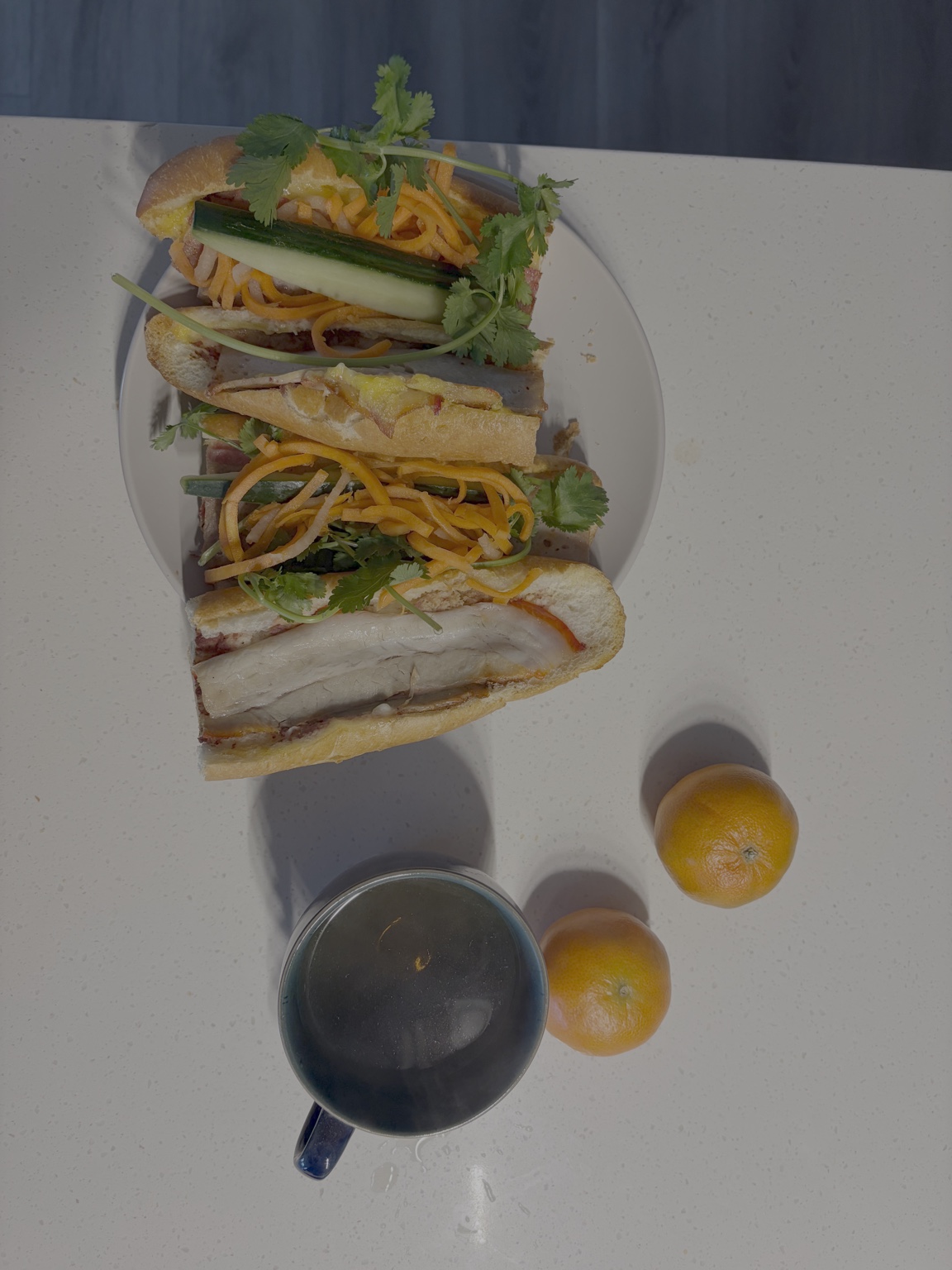
There is a quiet violence to inheritance. It tastes like fish sauce and metal spoons, like the back of the throat when you swallow words you never learned how to say. I was born between languages, between stories that survived by being whispered and a country that asked me to speak louder, clearer, simpler. My parents carried a war in their bones and called it gratitude. I learned early that love could sound like commands, that survival often dresses itself as silence.
We sit at the kitchen table and talk about practical things. Grades. Money. Weather. The past hovers nearby like a ghost no one acknowledges. It moves through the room anyway, brushing against our shoulders, settling into the cracks of the walls. I am told I am lucky. I am told this country is generous. I am told to be thankful and I am, but gratitude is a complicated muscle. It tightens when it is flexed too often. It aches when it is used to explain away pain.
I think of my parents as sailors who crossed an ocean without learning how to swim. They survived by gripping whatever floated. Faith. Family. The idea that suffering is temporary if you work hard enough. They reached shore and called it safety, but the water never really left them. It lives in their sleep, in the way they wake suddenly, in the way they measure abundance as if it might disappear if not counted twice. I inherited that vigilance. I carry it like a second spine.
Being second generation means living in the undertow. On the surface, everything looks calm. I speak without an accent. I know the rules. I understand the jokes. But underneath, there is a pull toward something older, heavier. A country I know mostly through photographs and food and the way my parents’ voices soften when they remember who they were before survival became their full-time job. I am always being tugged between what I am expected to become and what I am afraid of losing.
There is a particular kind of loneliness in this in-between. You are never quite enough of either shore. Too foreign to be fully claimed here, too distant to belong there. You learn to translate yourself constantly. To sand down the sharp edges of your family’s history so it fits neatly into conversations. You learn which parts of yourself are palatable and which should stay folded away like old letters written in a language no one wants to read.
My parents believe in sacrifice the way others believe in god. It is absolute. Unquestioned. They gave up everything so I could have choices, and that gift feels unbearably heavy. Every dream I chase drags their exhaustion behind it. Every failure feels like a betrayal. I am told to reach higher, but not too high. To be successful, but not reckless. To honor where I came from without lingering there too long. It is a narrow bridge, and the wind is unforgiving.
Sometimes I envy those who feel whole, who do not have to negotiate their existence. But there is also a strange strength in this fracture. I know how to hold contradictions without demanding they resolve. I know how to sit with discomfort. I know that love can be expressed as worry, that tenderness can sound like criticism, that silence can be a language all its own. These are not gentle lessons, but they are mine.
I am learning to forgive the distance between us. The distance between who my parents needed me to be and who I am becoming. The distance between the country that raised them and the one that raised me. Maybe identity is not about choosing a shore but about learning how to float, how to let the water hold you without pulling you under. Maybe the goal was never to arrive intact.
There is no clean ending to this story. Only motion. Only the slow, deliberate act of making space for myself without erasing what came before. I carry my parents’ names, their fear, their hope. I also carry my own hunger for something softer, something truer. I am not ungrateful for the crossing. I am just tired of pretending it did not leave me soaked to the bone.
The ocean did not spare us. It never does. But we crossed it anyway. And maybe that is the inheritance. Not wholeness. Not certainty. But the courage to keep moving, even when the water is cold, even when the shore is unclear, even when you are not sure which direction feels like home.